We buy everything we review ourselves — brands don't send us freebies or influence our opinions.
When you shop through our links, we may earn a commission at no extra cost to you. That's what keeps SRVogue honest and running.
Just Got a Safety First Ear Thermometer? Safety First Ear Thermometer setup

Table of Contents
Okay, real talk. My kid was fussy, I was already stressed, and I grabbed my brand-new Safety First ear thermometer thinking it would take me five seconds. I pointed it at his little ear, pressed the button, and it showed me 35.6.
Thirty-five point six.
I genuinely thought something was wrong with him — or the thermometer — or me. Turns out? It was reading in Celsius. The thermometer was perfectly fine. I just hadn’t done the Safety First ear thermometer setup correctly, and nobody warned me that this was step one.
If you’re here because you just unboxed yours and something looks off, I promise you’re not alone. This is the most common first-time use mistake with this thermometer, and it takes about ten seconds to fix. Let me walk you through everything I wish someone had told me.
What Comes in the Box (and What to Do First)
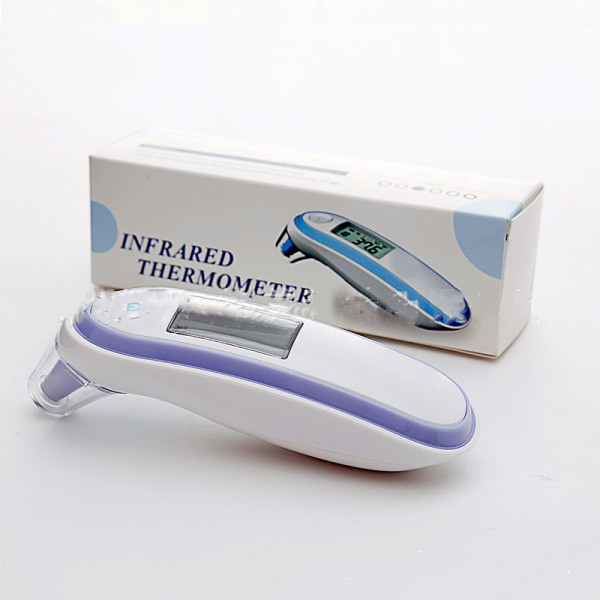
When you open the box, you’ll find the thermometer itself, a small storage case, a few disposable probe covers (called lens filters), a battery that’s usually already installed, and an instruction booklet that’s approximately the size of a postage stamp.
First thing? Don’t skip the probe covers. Those little plastic caps go on the tip of the thermometer before every use — they keep it hygienic and actually help with accuracy. You’ll get a few in the box, but you can buy refill packs separately.
Before you take a single temperature, check what mode you’re in. That’s the part nobody tells you upfront, and it’s exactly what caused my little Celsius panic moment.
Safety First Ear Thermometer Setup: The Very First Step
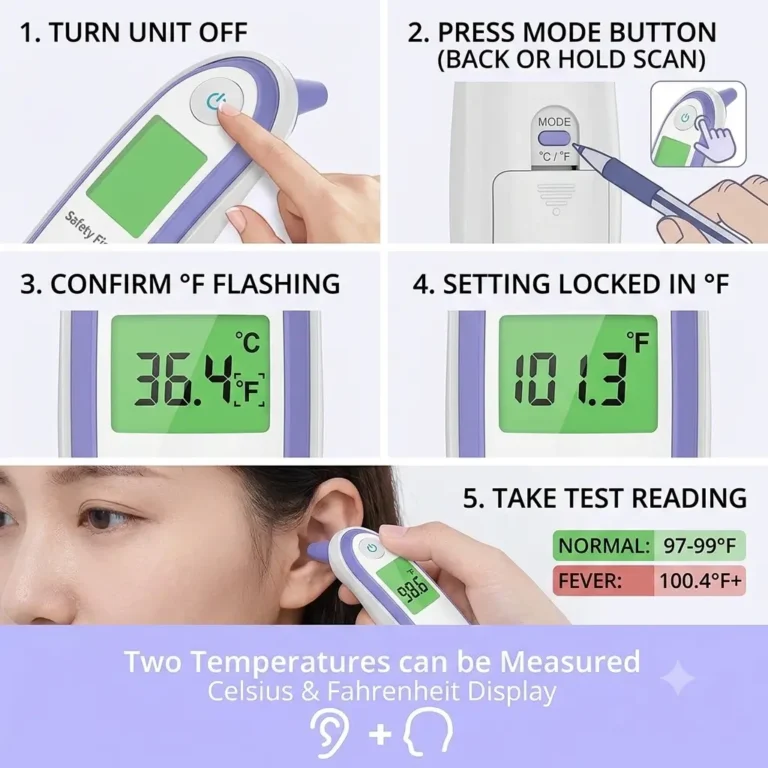
Here’s the thing about Safety First ear thermometer setup — the unit ships in Celsius by default. That’s totally normal, because these thermometers are sold internationally. But if you’re in the US, you want Fahrenheit, and you’ll want to switch it before you ever take a reading.
The good news is that the Safety First ear thermometer instructions for new users are actually pretty straightforward once you know where to look. The bad news is the instruction booklet buries this part.
Here’s what to do before anything else:
- Make sure the thermometer is off
- Press and hold the power button
- Watch the display — it’ll cycle through a quick startup sequence
- The unit toggle (C or F) will appear
Some models show a MODE button on the side instead. If yours has one, press and hold that for about 3–5 seconds until you see the unit change on the screen.
That’s genuinely it. Once you see “F” instead of “C” on the display, you’re set.
How to Change Your Safety First Ear Thermometer to Fahrenheit
Let me be more specific here because there are a couple of variations of this thermometer, and the process is slightly different depending on which one you have.
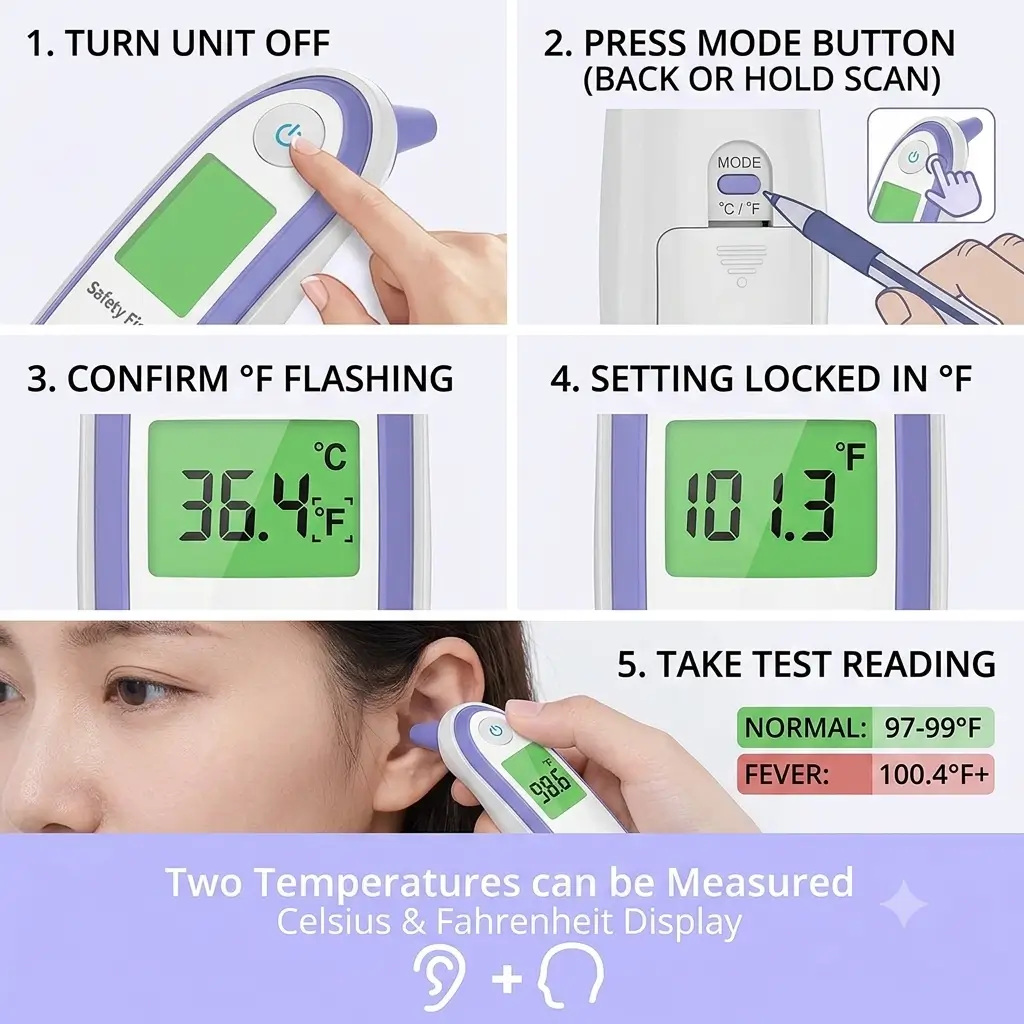
Most common method:
- Turn the thermometer off completely
- Press and hold the power button for 8–10 seconds
- The screen will flash and toggle between °C and °F
- Release when you see °F
If that doesn’t work:
- Look for a small MODE or UNIT button — sometimes it’s recessed and needs a pen tip to press
- Hold it for 3–5 seconds
- The display will switch units
To use the Safety First ear thermometer to change to Fahrenheit successfully, the key is making sure it’s fully powered off first. If it’s already on when you press and hold, it might just take a reading instead of entering settings mode. That tripped me up twice.
Once you’ve switched it, take a quick test reading on yourself — a normal adult ear temperature in Fahrenheit is around 97–99°F. If you’re seeing something in that range, you’re good to go.
How to Use a Safety First Ear Thermometer for the First Time
Alright, you’ve sorted the units. Now let’s actually use this thing.
Step-by-step for first-time use:
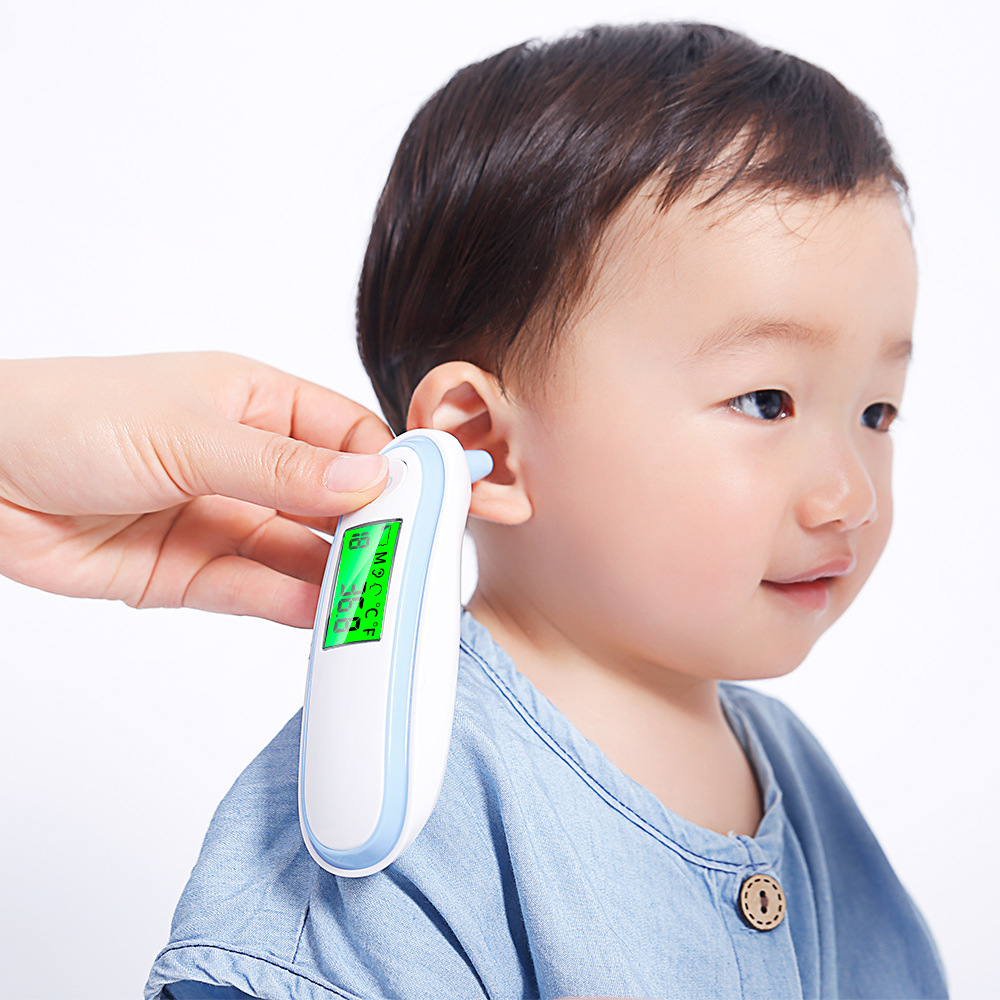
- Attach a probe cover — snap one onto the tip before every reading
- Gently pull the ear back — for kids over 1 year, gently pull the outer ear up and back to straighten the ear canal
- Insert the tip snugly — not deep, just enough to seal the canal opening
- Press the scan button and hold it for 1–2 seconds until you hear a beep
- Read the display — the temperature will appear within about a second
For babies under 12 months, pull the ear gently back and down rather than up. The ear canal is shaped differently in infants, and the angle matters for an accurate reading.
Additionally, let the thermometer sit at room temperature for about 30 minutes if you just brought it in from somewhere cold. Temperature extremes can throw off the reading temporarily. This is one of those Safety First thermometer beginner guide tips that nobody mentions but everyone should know.
Safety First Thermometer Beginner Tips I Wish I Knew Earlier
These aren’t in the instruction booklet — or if they are, they’re in font size 4 — so I’m just going to tell you directly.
Take three readings. Ear thermometers can vary slightly depending on positioning. I always take three quick readings and average them, or just go with the highest one. It sounds excessive but it takes maybe 30 extra seconds and gives you way more confidence in the number.
The ear has to be dry. If your kid just got out of the bath or was lying on that ear, wait a few minutes. Moisture and heat trapped against the ear can give you an inaccurate result.
Don’t use it right after coming inside from the cold. Give everyone — including the thermometer — about 15 minutes to adjust to room temperature first.
Ear infections can skew the reading. This is actually documented by health professionals — an infected ear can read higher than the other ear. If you suspect an ear infection, check both ears and note the difference.
Replace probe covers every single time. Reusing them is a sanitation issue and can also affect accuracy. The refill packs are cheap — just get them.
For more on how to use a Safety First ear thermometer accurately across different ages, [link to related post].
Is It Reading Correctly? What Normal Ear Temps Look Like
Once you’ve got your Safety First ear thermometer setup sorted and you’re getting readings in Fahrenheit, here’s what you should expect to see.
Normal ear temperature ranges:
- Adults: 97.0°F – 99.0°F (36.1°C – 37.2°C)
- Children (1–5 years): 97.0°F – 100.4°F
- Infants: 97.9°F – 100.4°F
A fever is generally defined as 100.4°F (38°C) or higher, regardless of age. However, always follow your pediatrician’s guidance — for newborns especially, even a low-grade fever warrants a call to the doctor.
If your reading looks wildly off — like 93°F or 104°F on a child who seems perfectly fine — reposition and try again. Positioning is usually the culprit. According to the American Academy of Pediatrics (AAP), ear thermometers are reliable when used correctly, but technique matters more than most people realize.
You’ve Got This — Promise
Look, the Safety First ear thermometer setup really is simple once you know what you’re doing. The Celsius-to-Fahrenheit switch is just one of those things that should be step one in the instructions but somehow isn’t labeled that way.
Now that your safety first ear thermometer first time use is sorted — unit switched, probe covers on, technique locked in — you’ll wonder how you ever managed without it. It’s genuinely one of the most useful things in our medicine cabinet, especially at 2am when you’re trying to figure out if that fever is real or you’re just an anxious parent (same, always).
Bookmark this page for your next new-parent friend. Trust me, they’ll thank you.
FAQs
Q: Why is my Safety First ear thermometer reading in Celsius? A: These thermometers ship in Celsius by default. To switch, power it off completely and press and hold the power or MODE button for 8–10 seconds until the display toggles to °F.
Q: How accurate is the Safety First ear thermometer? A: When used correctly with a clean probe cover and proper ear positioning, it’s clinically accurate to within ±0.4°F. Taking three readings and using the highest number improves reliability.
Q: Can I use this thermometer on a newborn? A: Most Safety First ear thermometers are approved for use from birth, but always check your specific model’s manual. For newborns under 3 months, a rectal thermometer is still considered the gold standard by most pediatricians.
Q: Why does my ear thermometer give different readings each time? A: Small variations in probe angle, ear canal moisture, or recent activity (lying down, being outside) can cause slight differences. Always take 2–3 readings and look for consistency.
Q: Do I need to use probe covers every time? A: Yes — every single reading. They’re not just for hygiene; they also protect the sensor lens and help maintain accuracy. Most models won’t read correctly without one in place.