We buy everything we review ourselves — brands don't send us freebies or influence our opinions.
When you shop through our links, we may earn a commission at no extra cost to you. That's what keeps SRVogue honest and running.
Safety First Ear Thermometer Celsius vs Fahrenheit: Which Setting Should You Use?

Table of Contents
It was maybe 11:30 at night. My daughter felt warm, I grabbed the thermometer, and it beeped back at me with 37.8.
I stared at that number for a solid ten seconds. Was that a fever? Was that fine? Was I supposed to know what 37.8 meant at midnight with a cranky toddler on my hip?
I didn’t. Because the Safety First ear thermometer was showing me Celsius, and my brain only thinks in Fahrenheit. The thermometer wasn’t broken. My daughter wasn’t in danger. I just had absolutely no idea which setting I was looking at or what the number meant.
If that scenario sounds familiar — or if you’re trying to avoid it entirely — this is the article for you. Understanding the Safety First ear thermometer Celsius vs Fahrenheit difference takes about three minutes, and knowing which setting to use will make every future temperature check so much less stressful. Let me walk you through all of it, including how to switch settings, what normal looks like in both units, and when a reading actually means you need to call the doctor.
Safety First Ear Thermometer Celsius vs Fahrenheit — What’s the Difference?
This sounds like a basic science question, but when you’re a tired parent holding a thermometer, it genuinely matters.
Celsius and Fahrenheit are just two different scales for measuring the same thing — body temperature. They’re not more or less accurate than each other. They just use different numbers to describe the same physical reality.
The key difference: normal body temperature is 37°C or 98.6°F. Those two numbers mean exactly the same thing. A fever threshold is 38°C or 100.4°F — again, identical in terms of what’s happening in your child’s body, just expressed differently depending on which scale your thermometer is set to.
The confusion comes because the numbers look so different. 37 sounds low. 98.6 sounds high. Neither instinct is correct — they’re the same temperature. That’s why knowing which unit your Safety First ear thermometer is currently displaying is the first thing you need to confirm before you interpret any reading.
Which Setting Should You Actually Use?
Here’s the simple answer: use whatever unit your doctor uses, because that’s the scale you’ll be describing readings in when you call them.
In the United States, Fahrenheit is standard. Most American pediatricians, nurses, and urgent care staff will ask for a temperature in °F. Therefore, if you’re in the US, set your thermometer to Fahrenheit — it removes the mental translation step entirely when you’re stressed and sleep-deprived.
In Canada, the UK, Australia, and most of Europe, Celsius is standard. If you’re in one of those countries, or if your doctor works in Celsius, use that setting instead.
There’s no medical reason to prefer one over the other. The Safety First ear thermometer which setting to use question comes down purely to your location and what your healthcare provider expects. Pick one, stick with it, and learn what normal looks like in that unit. That consistency is what makes temperature monitoring actually useful.
How to Switch Your Safety First Ear Thermometer Settings
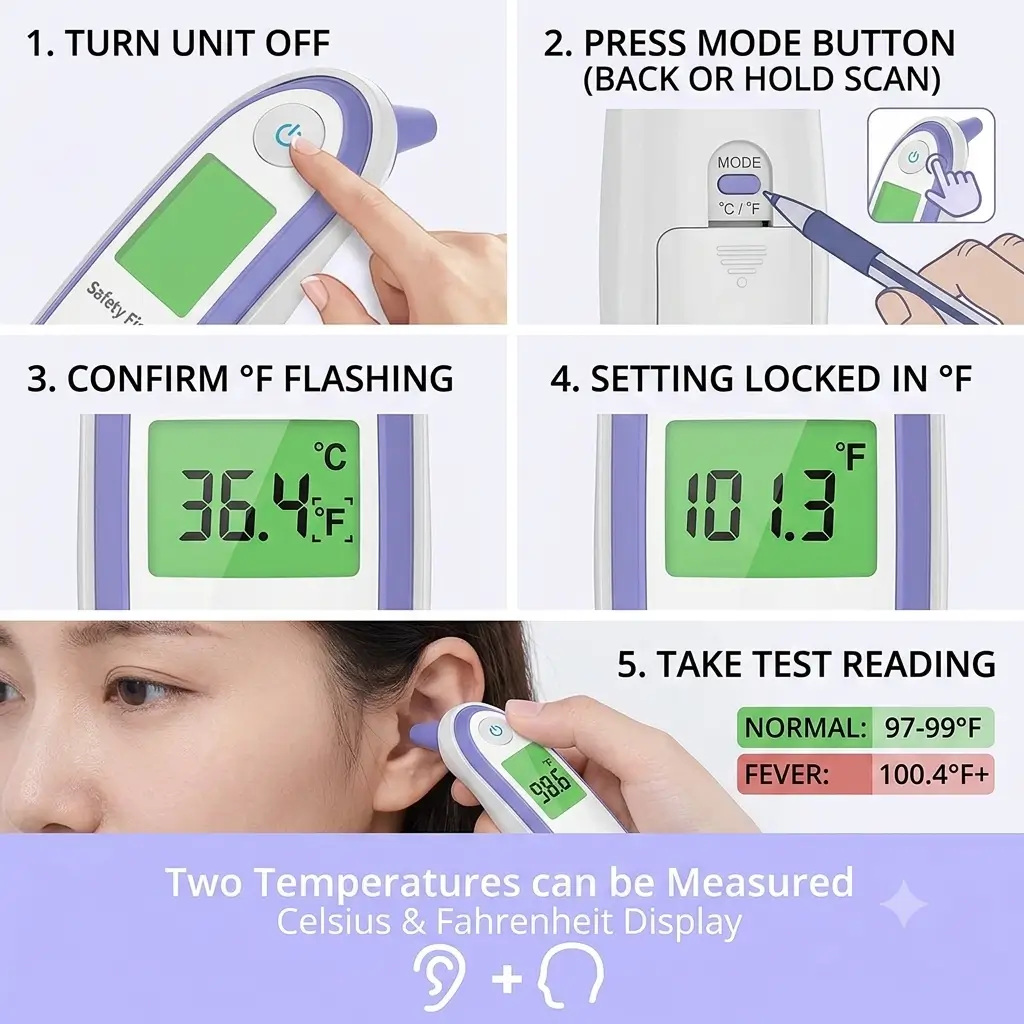
The good news is that switching between Celsius and Fahrenheit on a Safety First thermometer takes about ten seconds. The slightly annoying news is that the method varies slightly by model.
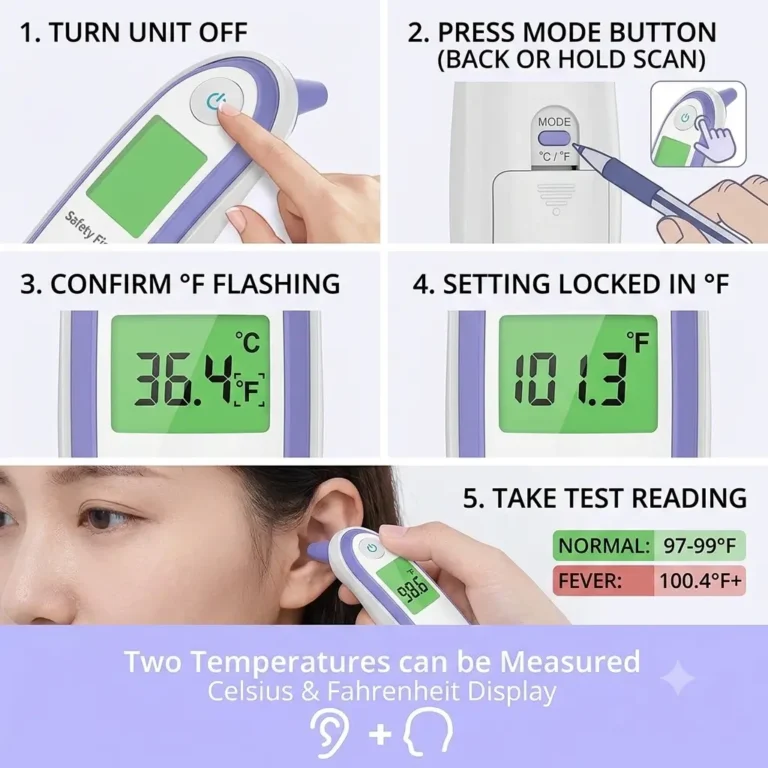
Most common method:
- Make sure the thermometer is fully powered off
- Press and hold the power button for 8–10 seconds
- Watch the screen — it will cycle and show either °C or °F
- Release when you see your preferred unit
If your model has a MODE or UNIT button:
- Power the device off completely
- Locate the MODE button (sometimes recessed — use a pen tip if needed)
- Press and hold for 3–5 seconds
- The display will toggle between units
The key that tripped me up: the thermometer must be off before you start. If it’s already on, holding the power button often just initiates a scan instead of entering settings mode.
Once you’ve switched, take a quick test reading on yourself. A normal adult result should land around 97–99°F or 36.1–37.2°C. If you’re seeing something in that range, your settings are correct and you’re good to go. For the full setup walkthrough, see Safety First Ear Thermometer review.
Normal Body Temperature in Celsius and Fahrenheit — Quick Reference
Bookmark this section. Screenshot it. Write it on a sticky note if you need to. This is the information that makes 2am so much less terrifying.
Normal body temperature:
- °F: 97.0 – 99.0°F (average 98.6°F)
- °C: 36.1 – 37.2°C (average 37°C)
Low-grade fever:
- °F: 99.1 – 100.3°F
- °C: 37.3 – 37.9°C
Fever (action threshold):
- °F: 100.4°F and above
- °C: 38°C and above
High fever:
- °F: 103°F and above
- °C: 39.4°C and above
Emergency — seek care immediately:
- °F: 104°F and above (or any fever in a newborn under 3 months)
- °C: 40°C and above
Normal body temperature in Celsius and Fahrenheit also varies slightly by person, time of day, and how active the child was before you took the reading. Additionally, ear thermometers can read slightly lower than rectal thermometers, which remain the clinical gold standard for infants. However, for everyday monitoring in children over one year, ear readings are reliable and fast.
Safety First Ear Thermometer Settings Explained (All the Symbols and Modes)
Beyond just the unit toggle, your Safety First thermometer probably has a few other indicators on the display that are worth understanding.
°C / °F symbol — This is simply which unit is active. Confirm this first before reading any temperature.
Backlit display — Some models use color-coded backlighting: green for normal, orange/yellow for low-grade fever, red for fever. This is genuinely helpful at night and isn’t indicating anything different from the number — it’s just a visual shorthand.
Memory indicator (M) — Shows that the device is displaying a stored previous reading rather than a new one. Press the scan button to take a fresh reading.
Low battery indicator — Usually a small battery icon that flashes. Replace the battery promptly because a dying battery can cause inaccurate or inconsistent readings.
Probe cover indicator — Some models won’t scan without a probe cover properly in place. If the device seems unresponsive, check that a clean lens filter is attached to the tip.
Having the Safety First ear thermometer settings explained in plain language makes those little symbols much less mysterious. Once you know what you’re looking at, the display becomes genuinely informative rather than confusing.
My Safety First Thermometer Reading Guide — How to Interpret Results
Getting a number is only half the job. Interpreting it correctly is what actually helps your child.
Take three readings. Ear thermometers are sensitive to positioning — a slightly off angle gives you a different number. I always take three readings in quick succession and either average them or use the highest one. It adds maybe 30 seconds and gives me much more confidence.
Consider timing. Body temperature naturally runs higher in the late afternoon and evening, and lower in the early morning. A 99.2°F reading at 6pm isn’t the same clinical picture as a 99.2°F reading at 6am. Context matters.
Compare to their baseline. Some kids run naturally warm or cool. If you know your child’s typical resting temperature, you’re better equipped to judge whether today’s reading is off. I started noting my daughter’s temperature during healthy stretches just to know her normal.
Don’t panic at a single number. One reading doesn’t tell the whole story. How does your child look and act? Are they drinking fluids? Lethargic or playing? A thermometer reading is one data point, not a diagnosis.
This safety first thermometer reading guide approach — multiple readings, context, behavior observation — is what most pediatric nurses will tell you too. The number matters, but it’s part of a bigger picture.
When Should You Call a Doctor? (Fever Thresholds in Both Units)
This is the section I wish someone had handed me when my daughter was first born. Here are the generally accepted guidelines, based on American Academy of Pediatrics fever guidance:
Call your doctor if:
- Your child is under 3 months and has any fever — 100.4°F (38°C) or higher. Don’t wait.
- Your child is 3–6 months with a fever of 101°F (38.3°C) or higher
- Any child has a fever of 103°F (39.4°C) or higher that doesn’t respond to medication
- Fever lasts more than 2–3 days regardless of temperature
- Your child seems unusually lethargic, won’t drink fluids, or has a rash alongside the fever
Go to the ER if:
- Temperature reaches 104°F (40°C) or higher
- Your child is having a febrile seizure
- There’s difficulty breathing, extreme lethargy, or signs of dehydration
These thresholds apply in both Celsius and Fahrenheit — the Celsius vs Fahrenheit thermometer reading question doesn’t change the medical response, only the number you’re looking at.
Now You’ve Got the Full Picture
Once you understand the Safety First ear thermometer Celsius vs Fahrenheit difference, the whole experience of using this thermometer changes. You stop second-guessing the number and start actually interpreting what it means.
Pick your unit — Fahrenheit if you’re in the US, Celsius if that’s what your doctor uses — switch the setting once, and commit to it. Learn the normal range in that unit. Know your child’s baseline. And keep this guide bookmarked for those 2am moments when you need a quick reference.
You can do this. And now that you understand Safety First ear thermometer which setting to use and why, you’re already ahead of most new parents who are just guessing.
For the full setup walkthrough and model comparison, don’t miss Safety First Ear Thermometer.
FAQs
Q: Does it matter whether I use Celsius or Fahrenheit on my Safety First thermometer? A: Medically, no — both scales measure the same temperature. Practically, yes — use whichever unit your doctor uses so you can communicate readings clearly without having to convert.
Q: What is a normal ear temperature in Fahrenheit? A: A normal ear temperature for most people is between 97.0°F and 99.0°F. Readings above 100.4°F are generally considered a fever.
Q: What is a normal ear temperature in Celsius? A: Normal range is approximately 36.1°C to 37.2°C. A reading of 38°C or above is considered a fever by most medical guidelines.
Q: My Safety First thermometer keeps switching back to Celsius — why? A: Some models reset to default (Celsius) when the battery is removed or replaced. After changing the battery, you may need to switch back to Fahrenheit through the settings process.
Q: Is an ear thermometer reading the same as a rectal reading? A: Not exactly. Ear temperatures typically read 0.3–0.5°F lower than rectal temperatures. Pediatricians often account for this — always mention you used an ear thermometer when reporting a temperature to your doctor.